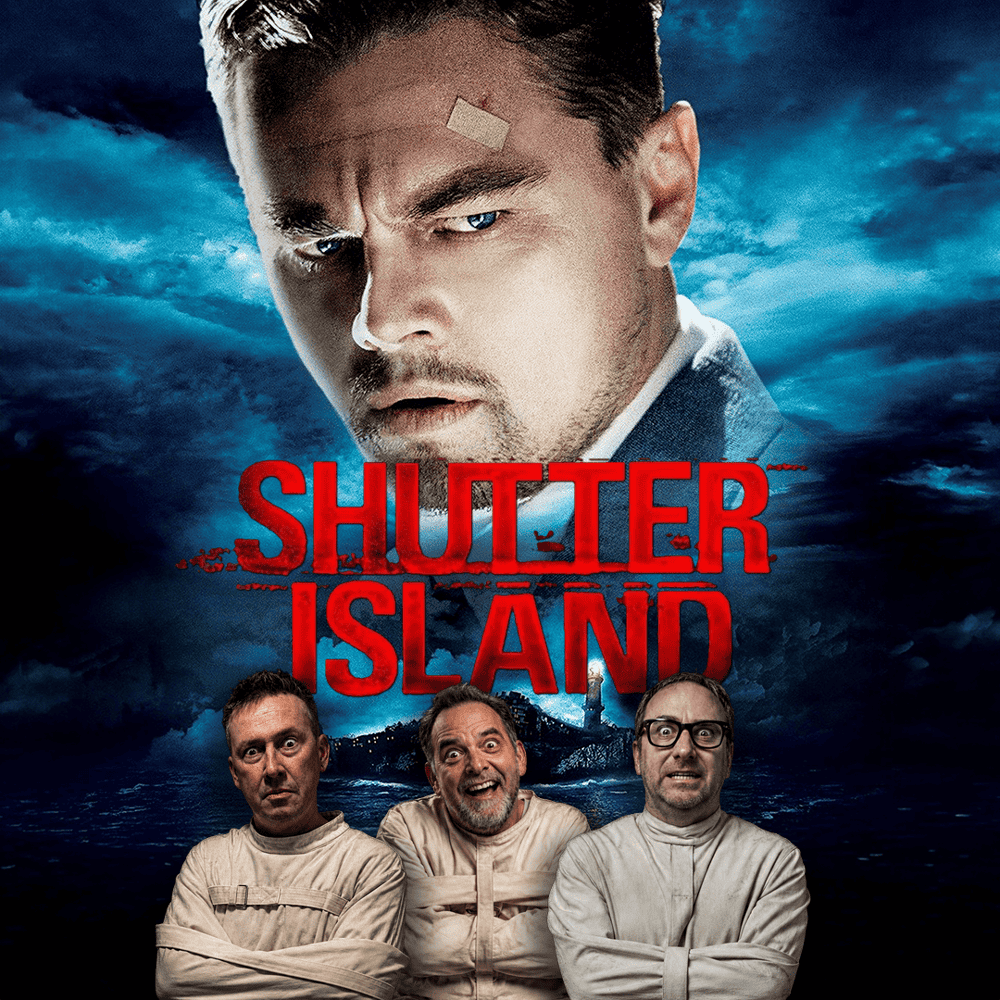
Details
Movie TitleShutter Island
Release DateFebruary 19, 2010 (USA); originally delayed from October 2, 2009
Tagline"Someone is missing."
Runtime138 min / 2h 18m
DirectorMartin Scorsese
ScreenplayLaeta Kalogridis
Based OnShutter Island (2003 novel) by Dennis Lehane
CinematographerRobert Richardson
Country of OriginUnited States
Sequel / FranchiseStandalone film; based on a standalone Dennis Lehane novel
Budget~$80 million
Box Office$128.1M domestic / $294.8M worldwide — a major commercial hit that far exceeded expectations for a cerebral psychological thriller
Rotten Tomatoes68% Critics / 88% Audience
Metacritic63 / 100 · 7.5 User
IMDb Rating8.2/10
MPAA RatingR — For disturbing violent content, language, and some nudity
Content WarningsGraphic violence, disturbing imagery of war atrocities (Dachau), depictions of child death, strong language, brief nudity, themes of mental illness and trauma, drowning sequences
Where to WatchParamount+ (subscription); available for rent/purchase on Amazon Prime Video, Apple TV+, Vudu, and Google Play. May vary by region.
Main Cast
Leonardo DiCaprioU.S. Marshal Teddy Daniels
Mark RuffaloU.S. Marshal Chuck Aule
Ben KingsleyDr. John Cawley
Max von SydowDr. John Naehring
Michelle WilliamsDolores Chanal (Teddy's Wife)
Emily MortimerRachel Solando #1
Patricia ClarksonRachel Solando #2 (the real Rachel)
Jackie Earle HaleyGeorge Noyce
Ted LevineWarden
John Carroll LynchDeputy Warden McPherson
Elias KoteasAndrew Laeddis
Robin BartlettNurse Marino
Awards
⭐ Saturn Awards — Best Thriller Film — Nominated — 2011
⭐ Saturn Awards — Best Actor (Leonardo DiCaprio) — Nominated — 2011
⭐ Saturn Awards — Best Supporting Actor (Ben Kingsley) — Nominated — 2011
⭐ MTV Movie Awards — Best Male Performance (Leonardo DiCaprio) — Nominated — 2010
⭐ People's Choice Awards — Favorite Thriller — Nominated — 2011
⭐ BMI Film & TV Awards — BMI Film Music Award (Robbie Robertson) — Won — 2010
⭐ Art Directors Guild — Excellence in Production Design (Kristi Zea) — Nominated — 2011
⭐ Empire Awards — Best Thriller — Nominated — 2011
Plot Summary
In 1954, U.S. Marshals Teddy Daniels (Leonardo DiCaprio) and his new partner Chuck Aule (Mark Ruffalo) travel by ferry to Ashecliffe Hospital on the remote Shutter Island, a maximum-security psychiatric facility for the criminally insane, to investigate the mysterious disappearance of patient Rachel Solando — a woman who seemingly vanished from a locked room without a trace. As a massive hurricane traps the marshals on the island, Teddy is increasingly haunted by nightmares involving his late wife Dolores and vivid flashbacks to his liberation of the Dachau concentration camp during World War II. The more Teddy probes the facility's secretive staff and its enigmatic lead psychiatrist Dr. John Cawley (Ben Kingsley), the more he becomes convinced the institution is conducting horrific government-sanctioned experiments on patients. The film's shocking climax reveals that Teddy Daniels is in fact Andrew Laeddis, a patient at Ashecliffe himself, who drowned his own children and murdered his wife after her mental illness was left untreated — and that the entire investigation was an elaborate role-play orchestrated by Cawley to break through his delusion. The devastating final line — "Which would be worse: to live as a monster, or to die as a good man?" — suggests that Laeddis may have chosen lobotomy over accepting the truth of what he has done.
↑ Return to Top
Key Quotes
"Which would be worse — to live as a monster, or to die as a good man?" — Teddy Daniels / Andrew Laeddis
"You're a rat in a maze. And you keep trying to find a way out. But you can't get out. Because you were never supposed to." — George Noyce
"I can't get off this island. Neither can you." — Warden
"You're not investigating anything. You ARE the experiment." — George Noyce
"This place is a fortress, Chuck. Ashecliffe isn't built to keep the patients in... it's built to keep people out." — Teddy Daniels
"I'm not crazy. I know how that sounds, but I'm not crazy." — Teddy Daniels
Trivia
Director
- Martin Scorsese has cited classic Hollywood psychological thrillers — particularly films by Alfred Hitchcock such as Vertigo (1958) — as a primary stylistic influence on Shutter Island's unsettling visual grammar.
- Scorsese described the film as an homage to the B-movie Gothic horror films he watched as a child in the 1950s, especially those produced by Val Lewton at RKO.
- This was Scorsese's fourth consecutive collaboration with Leonardo DiCaprio, following Gangs of New York (2002), The Aviator (2004), and The Departed (2006).
- Scorsese deliberately used a wide-angle lens and unusual camera angles throughout the film to create a pervasive sense of unease and disorientation, reinforcing the unreliable narrator structure.
- The director drew on the expressionist cinematography of German 1920s–30s horror cinema and film noir to construct the film's oppressive visual atmosphere.
Cast / Casting
- Leonardo DiCaprio has said this is among the most psychologically demanding roles of his career, requiring him to essentially portray two completely different men — a hero and a broken killer — at once.
- Mark Ruffalo was cast as Chuck Aule before he had been cast as Bruce Banner / The Hulk in the Marvel Cinematic Universe; Scorsese praised his naturalistic screen presence as the ideal foil for DiCaprio's intensity.
- Ben Kingsley prepared for the role of Dr. Cawley by extensively researching 1950s psychiatric practices and the real-world history of lobotomies and experimental treatments at American institutions of the era.
- Max von Sydow's casting as the ominous Dr. Naehring was a deliberate nod to the horror tradition — the Swedish legend was best known at that point for his role in The Exorcist (1973).
- Michelle Williams, who plays Teddy's doomed wife Dolores, was largely filmed on controlled soundstages in dreamlike sequences that required weeks of separate, isolated shooting.
Soundtrack / Score
- Robbie Robertson — legendary guitarist and songwriter for The Band — served as music supervisor and compiled the film's score from a patchwork of existing classical and avant-garde 20th-century compositions.
- The film does not have a single original composed score; instead, Robertson curated pieces by composers including John Cage, Penderecki, Ligeti, Scelsi, and Max Richter to create its dissonant, nightmarish soundscape.
- The opening title sequence uses "Fog Tropes" by Ingram Marshall — a haunting, minimalist piece for brass ensemble and foghorn sounds — which immediately establishes the film's island isolation and dread.
- Krzystof Penderecki's "Polymorphia" — also famously used in The Shining (1980) — appears in the film, drawing a deliberate stylistic line between Shutter Island and Stanley Kubrick's horror classic.
- Robertson won the BMI Film Music Award for his work assembling the soundtrack, which became critically noted for how effectively existing classical pieces were repurposed as an original horror score.
Location
- The island asylum exteriors were shot primarily at Medfield State Hospital, a real and long-abandoned psychiatric facility in Medfield, Massachusetts, which closed in 2003.
- Additional exterior lighthouse and cliff scenes were filmed on Peddocks Island in Boston Harbor — one of the actual islands in the Harbor Islands State Park.
- Interior scenes were largely built on stages at the Borderland State Park in Easton, Massachusetts, and at various Boston-area locations.
- The ferry sequences were filmed on Boston Harbor, giving the film an authentic New England nautical atmosphere consistent with the novel's setting.
- The Dachau liberation flashback sequences were filmed in specially dressed locations in Massachusetts designed to replicate the bleak, snow-covered grounds of the Nazi concentration camp.
Behind-The-Scenes
- The film's release was controversially moved from its original October 2, 2009 date to February 19, 2010 — a relatively rare move by Paramount, who cited the need for additional time to market the film properly; some suspected Oscar positioning was being avoided.
- Screenwriter Laeta Kalogridis worked closely with Dennis Lehane to adapt the novel, preserving his key structural twist while streamlining the story for a two-hour-plus film format.
- Production designer Kristi Zea and cinematographer Robert Richardson worked extensively together to achieve the film's oppressive color palette — desaturated blues and greens in the "real" world vs. warmer, almost lurid tones in Teddy's hallucinations.
- The storm sequences required a major practical effects effort — real hurricane-force wind machines and rain rigs were used on location in Massachusetts rather than relying entirely on visual effects.
- A deliberate choice was made to shoot on 35mm film rather than digital to evoke the 1950s period setting and give the image a grainy, slightly dreamlike quality consistent with the era and the protagonist's fractured perception.
Nostalgia
- The film is set in 1954 — the height of the McCarthy era and Cold War paranoia — and draws heavily on the period's genuine anxieties about government overreach, mind control, and institutional abuse.
- The 1950s psychiatric ward setting evokes a period in American history when lobotomy was still a practiced medical procedure, and the film references real debates of the era between talk-therapy and more invasive surgical interventions.
- The Federal Marshal costumes, automobiles, and set dressing are meticulously period-accurate, grounding the psychological surrealism in a recognizable mid-century American aesthetic.
- For many audiences, Shutter Island was their first exposure to the "unreliable narrator" thriller as a mainstream cinematic form — a gateway to earlier classics like Vertigo, Jacob's Ladder, and The Sixth Sense.
- The film arrived at a moment — 2010 — when DiCaprio was at the apex of his leading-man stardom, making it a genuine cultural event for the generation who grew up watching him in Titanic.
Easter Eggs
- The names "Teddy Daniels" and "Andrew Laeddis" are anagrams of each other, as are "Rachel Solando" and "Dolores Chanal" — a puzzle hidden in plain sight throughout the film that rewards attentive viewers on a second watch.
- The film's opening shot of the ferry emerging from fog is a visual homage to the opening of Alfred Hitchcock's Rebecca (1940) — another tale of a man haunted by a woman's death on a forbidding estate.
- Ward C — the most dangerous wing of Ashecliffe — is labeled with the number 67 on several interior signs, a possible nod to Paramount's address at 5555 Melrose Avenue, Stage 67, where portions of interior scenes were prepped.
- The children's drawings Teddy finds in Rachel's cell spell out "RUN" when placed in the correct sequence — visible only on careful frame-by-frame examination.
- Several background orderlies in the asylum scenes are played by actual clinical psychology students from local Boston universities, cast deliberately by Scorsese to bring an authentic behavioral naturalism to the background.
Misc.
- Shutter Island grossed $294.8 million worldwide against an $80 million production budget, making it one of the most commercially successful films of Scorsese's career at that time.
- The film holds an 8.2 / 10 rating on IMDb from over 1.4 million user votes — one of the highest-rated psychological thrillers on the platform and a clear example of audience appreciation outpacing critical consensus.
- Dennis Lehane, who also wrote the novels behind Mystic River and Gone Baby Gone, has described Shutter Island as his most personal book — inspired in part by his father's experience with mental illness.
- The film was released on the same weekend as the 2010 Winter Olympics opening ceremony, yet still opened at #1 with a dominant $41 million debut weekend.
- A notable internet debate persists to this day regarding the film's final scene — specifically whether Andrew Laeddis has truly regressed into delusion or has consciously chosen to "become" Teddy Daniels one last time as a form of self-willed death.
Soundtrack
Shutter Island (Music from the Motion Picture) Various Artists / Music Supervision by Robin Urdang · 39 tracks · N/A
1
Fog Tropes
Ingram Marshall / Kronos Quartet
8:37
2
On the Nature of Daylight
Max Richter
6:00
3
Uaxuctum: The Legend of the Maya City
György Ligeti / Orchestre Philharmonique de Radio France
7:36
4
Lontano
György Ligeti / Berlin Philharmonic, Jonathan Nott
11:10
5
Suite from "Shutter Island"
Robbie Robertson
7:06
6
Cry Me a River
Julie London
3:09
7
The House I Live In (That's America to Me)
Frank Sinatra
3:14
8
Symphonie fantastique, Op. 14: V. Songe d'une nuit du sabbat
Hector Berlioz / London Symphony Orchestra, Colin Davis
9:54
9
Piano Concerto No. 3 in D Minor, Op. 30: III. Finale (Alla breve)
Sergei Rachmaninoff / Philadelphia Orchestra, Eugene Ormandy
13:24
10
This Bitter Earth / On the Nature of Daylight
Dinah Washington / Max Richter
3:52
11
Pura Colonia
Emerson, Lake & Palmer
5:54
12
Music for Piano and Orchestra, Op. 22: II
Ernst Krenek / Robert Goldsand, Vienna Pro Musica Orchestra
3:59
13
The Howling
Robbie Robertson & The Red Road Ensemble
3:47
14
Solo Viola (from "Shutter Island")
Max Richter
3:10
—
Additional tracks — full tracklist unverified
If You Liked This, Watch Next
Other movies reviewed by 3 Guys and a Flick that fans of Shutter Island tend to love — all rated above 3.5.
↑ Return to Top
Sources Cited
3 Guys and a Flick - Latest Episode
3 Guys and a Flick - Ratings
IMDb - Shutter Island
IMDb - Full Cast & Crew
IMDb - Awards
IMDb - Quotes
IMDb - Taglines
IMDb - Soundtrack
IMDb - Filming Locations
IMDb - Trivia
Box Office Mojo - Shutter Island
The Numbers - Shutter Island
Rotten Tomatoes - Shutter Island
Metacritic - Shutter Island
Wikipedia - Shutter Island
Show notes generated June 17, 2026. Content reflects information available at time of generation.
↑ Return to Top