Details
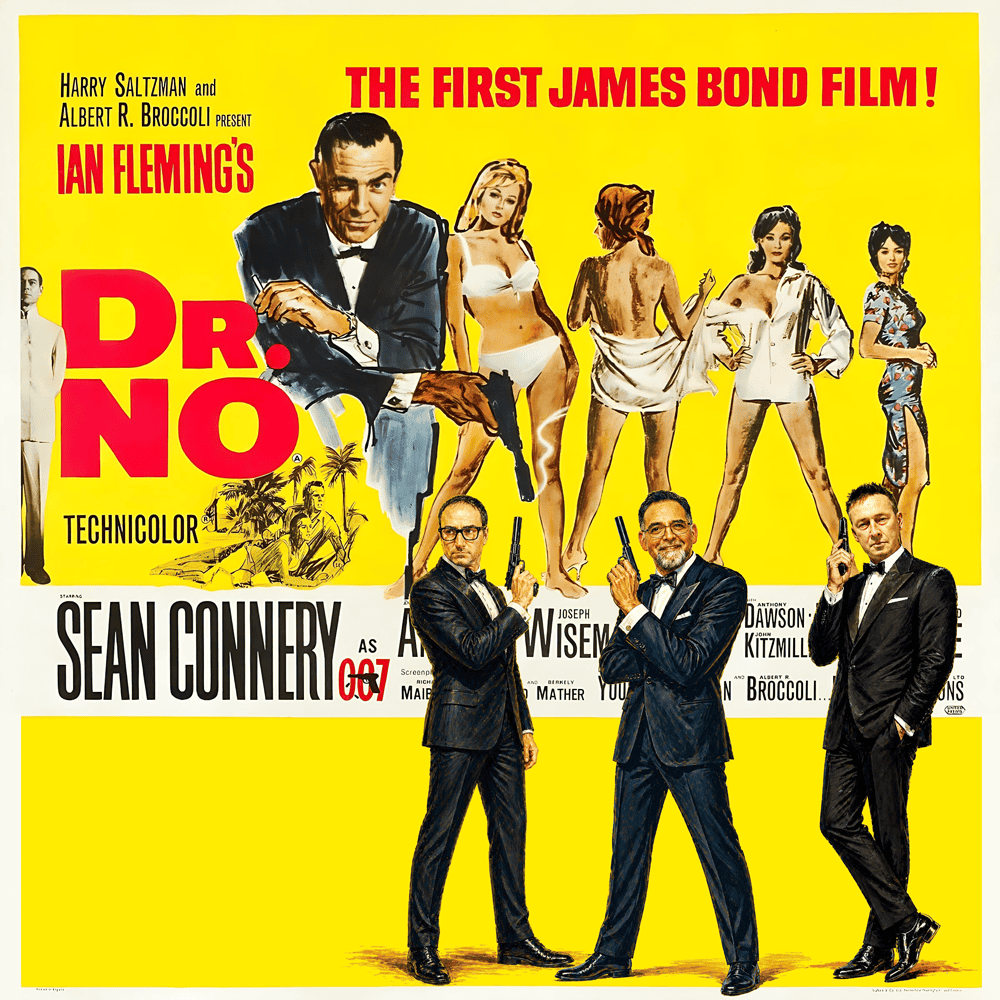
Movie TitleDr. No
Release DateOctober 5, 1962, UK premiere / May 8, 1963, U.S. release
Tagline“Now meet the most extraordinary gentleman spy in all fiction!”
Runtime109 minutes
DirectorTerence Young
Screenplay Written ByRichard Maibaum, Johanna Harwood, and Berkely Mather
Based OnDr. No, the 1958 James Bond novel by Ian Fleming
Is It a Remake?No. It is the first official Eon Productions James Bond film.
BudgetApproximately $1 million to $1.1 million
Box OfficeApproximately $16.1 million domestic / approximately $59.6 million worldwide
Main Cast
Sean ConneryJames Bond
Ursula AndressHoney Ryder
Joseph WisemanDr. No
Jack LordFelix Leiter
Bernard LeeM
Anthony DawsonProfessor R. J. Dent
Zena MarshallMiss Taro
John KitzmillerQuarrel
Eunice GaysonSylvia Trench
Lois MaxwellMiss Moneypenny
Peter BurtonMajor Boothroyd
Yvonne ShimaSister Lily
Awards
⭐ No major Academy Award wins or nominations have been verified for Dr. No.
⭐ IMDb’s awards listing does not show major contemporary competitive awards for the film itself.
⭐ While not a major awards contender at the time, Dr. No became historically significant as the first official James Bond feature film.
Short Plot Summary
British Secret Service agent James Bond is sent to Jamaica to investigate the disappearance of fellow MI6 operative John Strangways and his secretary. The trail leads Bond through casinos, assassins, spies, and local allies before pointing toward Crab Key, a mysterious island controlled by the reclusive scientist Dr. No. There, Bond uncovers a plot to disrupt the American space program and faces the first cinematic villain in what would become the world’s longest-running spy franchise.
↑ Return to Top
Key Quotes
“Bond. James Bond.” — James Bond
“That’s a Smith & Wesson, and you’ve had your six.” — James Bond
“World domination. Same old dream.” — James Bond
“I admire your courage, Miss…?” — James Bond
“Trench. Sylvia Trench.” — Sylvia Trench
Trivia
Director
- Terence Young directed Dr. No and helped define Sean Connery’s early screen version of Bond: cool, controlled, physically confident, and dryly humorous.
- The film was produced by Harry Saltzman and Albert R. Broccoli for Eon Productions, launching the long-running official Bond film series.
- The film had its London premiere on October 5, 1962, with its U.S. release following in 1963.
- Young’s direction established core Bond elements including exotic locations, dangerous seduction, stylized violence, villain lairs, and a hero who treats life-threatening situations like an inconvenience.
Cast / Casting
- Sean Connery made his first appearance as James Bond in this film.
- Ursula Andress played Honey Ryder; her beach entrance became one of the most iconic introductions in the Bond franchise.
- Joseph Wiseman played Dr. No, the first major cinematic Bond villain.
- Jack Lord played CIA agent Felix Leiter, marking the character’s first appearance in the film series.
- Eunice Gayson played Sylvia Trench, the woman involved in Bond’s first on-screen “Bond. James Bond.” introduction.
Soundtrack / Score
- Monty Norman is credited with the film’s music.
- AFI lists “James Bond Theme” as performed by the John Barry Orchestra.
- The “James Bond Theme” became one of the most recognizable pieces of film music in cinema history and a crucial part of the franchise identity.
- The film’s Jamaican setting also uses Caribbean-influenced music, helping tie the spy mystery to its island location.
Location
- The story is set largely in Jamaica and on the fictional island of Crab Key.
- AFI lists geographic locations connected to the production including England, Ocho Rios, Falmouth, Kingston, and St. Ann, Jamaica.
- The Jamaica locations helped give the first Bond film a strong travel-adventure identity, which became a key part of the franchise formula.
- Studio work was handled in the United Kingdom, while location filming helped give the film scale despite its relatively modest budget.
Behind-The-Scenes
- Dr. No was produced on a relatively small budget, commonly reported around $1 million to $1.1 million.
- The film’s success launched the official Eon Productions James Bond franchise, with From Russia with Love following in 1963.
- Production began in January 1962, according to AFI Catalog notes.
- The villain’s island lair helped establish the Bond tradition of elaborate enemy headquarters, a visual language that would become even bigger in later entries.
Nostalgia
- This is where the movie version of James Bond truly begins: the card table, the tuxedo, the cigarette, and the immortal “Bond. James Bond.”
- Compared with later Bond films, Dr. No is leaner and less gadget-heavy, but the basic formula is already there: exotic travel, espionage, danger, seduction, and a larger-than-life villain.
- Honey Ryder’s ocean entrance became one of the defining images of early Bond cinema.
- The movie captures early-1960s Cold War and Space Race anxieties, wrapping them in escapist spy adventure.
Easter Eggs
- The film introduces the gun-barrel opening, one of the most durable visual signatures in movie history.
- Sylvia Trench’s name setup allows Bond to deliver his name in reverse structure after she introduces herself as “Trench. Sylvia Trench.”
- Bond is issued the Walther PPK, replacing his earlier Beretta, a detail that became part of the character’s screen identity.
- The film’s mix of casinos, exotic travel, espionage, gadgets, danger, and seduction became the foundation for the Bond formula.
Misc.
- Dr. No was released in the United Kingdom in 1962 and in the United States in 1963.
- The Numbers lists the film with a production budget of $1 million, domestic box office of $16,067,035, and worldwide box office of $59,566,680.
- AFI identifies the film as part of the James Bond series and confirms it is based on Ian Fleming’s 1958 novel.
- Your 3 Guys and a Flick ratings page lists Dr. No as Episode 261 with an overall rating of 3.08.
Sources Cited
3 Guys and a Flick — Podcast 261: Dr. No
3 Guys and a Flick — Ratings
Podbean — Podcast 261: Dr. No
IMDb — Dr. No
IMDb — Dr. No Full Cast & Crew
IMDb — Dr. No Awards
IMDb — Dr. No Quotes
AFI Catalog — Dr. No
Box Office Mojo — Dr. No
The Numbers — Dr. No
Rotten Tomatoes — Dr. No
Wikipedia — Dr. No
↑ Return to Top