Details
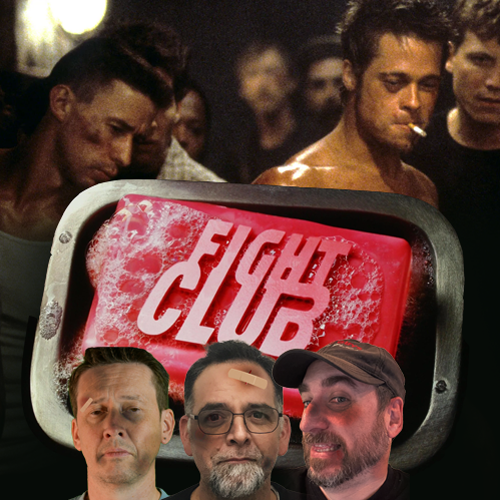
Movie TitleFight Club
Release DateVenice premiere: September 10, 1999 / U.S. release: October 15, 1999
TaglineMischief. Mayhem. Soap.
Runtime139 minutes / 2 hours 19 minutes
DirectorDavid Fincher
Screenplay Written ByJim Uhls
Based OnThe 1996 novel Fight Club by Chuck Palahniuk
Is It a Remake?No. It is an adaptation of Chuck Palahniuk’s novel, not a remake of an earlier film.
BudgetApproximately $63–65 million
Box OfficeApprox. $38.0 million domestic / approx. $101.8 million worldwide
Main Cast
Edward NortonNarrator
Brad PittTyler Durden
Helena Bonham CarterMarla Singer
Meat Loaf AdayRobert “Bob” Paulsen
Jared LetoAngel Face
Zach GrenierRichard Chesler
Holt McCallanyThe Mechanic
Eion BaileyRicky
Richmond ArquetteIntern
David AndrewsThomas
George MaguireGroup Leader
Eugenie BondurantWeeping Woman
Christina CabotGroup Leader
Rachel SingerChloe
Michael Shamus WilesBartender
Peter IacangeloLou
Thom Gossom Jr.Detective Stern
Mark FiteSecond Man at Auto Shop
Awards
⭐ Academy Award Nominee — Best Effects, Sound Effects Editing
⭐ Empire Award Winner — Best British Actress: Helena Bonham Carter
⭐ Online Film Critics Society Nominee — Best Film
⭐ Online Film Critics Society Nominee — Best Director: David Fincher
⭐ Online Film Critics Society Nominee — Best Actor: Edward Norton
⭐ Online Film Critics Society Nominee — Best Editing: James Haygood
⭐ Online Film Critics Society Nominee — Best Adapted Screenplay: Jim Uhls
⭐ BRIT Award Nominee — Soundtrack / cast recording category recognition
⭐ No Academy Award win was verified for the film.
⭐ No Golden Globe or BAFTA nominations were verified for the film.
Short Plot Summary
An unnamed, sleep-deprived office worker drifts through a numb life of corporate routine, catalog shopping, and support groups until he meets Tyler Durden, a charismatic soap salesman who seems to reject everything modern life has taught him to want. Together they create Fight Club, an underground space where men beat each other to feel something real. But as Fight Club grows into Project Mayhem, the Narrator realizes Tyler’s rebellion has become something far more dangerous — and far more personal — than he ever understood.
↑ Return to Top
Key Quotes
“The first rule of Fight Club is: you do not talk about Fight Club.” — Tyler Durden
“The second rule of Fight Club is: you do not talk about Fight Club.” — Tyler Durden
“This is your life, and it’s ending one minute at a time.” — Narrator
“It’s only after we’ve lost everything that we’re free to do anything.” — Tyler Durden
“His name is Robert Paulsen.” — Fight Club members
“You met me at a very strange time in my life.” — Narrator
Trivia
Director
- Fight Club was directed by David Fincher.
- The screenplay was written by Jim Uhls, adapting Chuck Palahniuk’s 1996 novel.
- AFI lists Art Linson, Ceán Chaffin, and Ross Grayson Bell as producers.
- The film helped cement Fincher’s reputation for dark, controlled, visually aggressive storytelling after Se7en and The Game.
- Fincher frames the story as a toxic identity crisis, consumer-culture satire, and psychological thriller disguised as a bare-knuckle rebellion fantasy.
Cast / Casting
- Edward Norton plays the unnamed Narrator, an insomniac office worker whose dissatisfaction drives the story.
- Brad Pitt plays Tyler Durden, the magnetic soap salesman who becomes the face of the Narrator’s rebellion.
- Helena Bonham Carter plays Marla Singer, whose self-destructive behavior mirrors and disrupts the Narrator’s own spiral.
- Meat Loaf Aday plays Robert “Bob” Paulsen, one of the film’s most memorable tragic figures.
- Jared Leto plays Angel Face, one of the recruits pulled into Tyler’s expanding movement.
- Holt McCallany plays The Mechanic, years before later becoming closely associated with Fincher’s Mindhunter.
Soundtrack / Score
- The score was composed by The Dust Brothers.
- AFI credits The Dust Brothers for the film’s music, helping give the movie its abrasive electronic identity.
- The closing scene famously uses Pixies’ “Where Is My Mind?”
- The soundtrack’s loops, scratches, beats, and industrial textures match the film’s fractured, anti-corporate nervous system.
- The film received an Academy Award nomination for Sound Effects Editing, reinforcing how important sound is to the movie’s impact.
Location
- The film was shot largely in and around Los Angeles.
- IMDb lists filming locations including Los Angeles, Century City, Wilmington, and San Pedro, California.
- The movie’s anonymous urban setting helps the Narrator feel trapped inside corporate spaces, airports, basements, and half-lit rooms rather than a specific hometown.
- The production design by Alex McDowell creates a world of grim apartments, sterile offices, support-group basements, and decaying industrial spaces.
- The house on Paper Street becomes one of the movie’s signature locations: filthy, collapsing, and weirdly perfect for Tyler’s anti-consumer manifesto.
Behind-The-Scenes
- Jeff Cronenweth served as cinematographer, and James Haygood edited the film.
- AFI lists Alex McDowell as production designer.
- The film’s budget is commonly reported around $63–65 million.
- The film opened at number one domestically but underperformed against studio expectations during its theatrical run.
- The Numbers lists worldwide box office at $101,793,884.
- The movie found a much larger cultural life on home video, becoming one of the defining cult films of the late 1990s.
Nostalgia
- Fight Club went from controversial studio headache to one of the most quoted cult movies of its era.
- The first two rules of Fight Club became instantly recognizable pop-culture lines.
- The film’s critique of consumerism, masculinity, alienation, and empty rebellion has kept it debated for decades.
- Its reputation has shifted over time, with viewers arguing over whether the film condemns Tyler’s worldview, glamorizes it, or does both on purpose.
- For movie fans, it remains peak late-’90s mayhem: dirty visuals, sharp editing, unreliable narration, a killer twist, and one of the best final music drops of the decade.
Easter Eggs
- Tyler Durden appears in quick single-frame flashes before the Narrator formally meets him.
- The film hides clues to the Narrator/Tyler connection throughout the story, especially in their conversations and physical staging.
- The “I am Jack’s…” narration echoes old Reader’s Digest-style body-organ articles, twisted into the Narrator’s breakdown.
- The cigarette-burn splice gag connects directly to Tyler’s job as a projectionist and the movie’s obsession with hidden images.
- The final shot’s film-splice joke is exactly the kind of cinematic vandalism Tyler would approve of.
Misc.
- Fight Club is rated R.
- AFI lists the film as an adaptation of Chuck Palahniuk’s novel.
- The movie’s theatrical performance was considered disappointing, but its home-video life helped turn it into a cult classic.
- Rotten Tomatoes and Metacritic both preserve its long-running critical conversation as a divisive but influential modern film.
- Your 3 Guys and a Flick ratings page lists the episode as Episode 171, with Don rating it 2.75, Ken rating it 4.50, Jon rating it 4.00, and an overall rating of 3.75.
Sources Cited
3 Guys and a Flick — Podcast 171: Fight Club
3 Guys and a Flick — Ratings
AFI Catalog — Fight Club
20th Century Studios — Fight Club
IMDb — Fight Club
IMDb — Full Cast & Crew
IMDb — Awards
IMDb — Quotes
IMDb — Taglines
IMDb — Soundtrack
IMDb — Filming Locations
Box Office Mojo — Fight Club
The Numbers — Fight Club
Rotten Tomatoes — Fight Club
Metacritic — Fight Club
The Academy — 72nd Oscars
Movie-Locations.com — Fight Club Filming Locations
Wikipedia — Fight Club
↑ Return to Top