Details
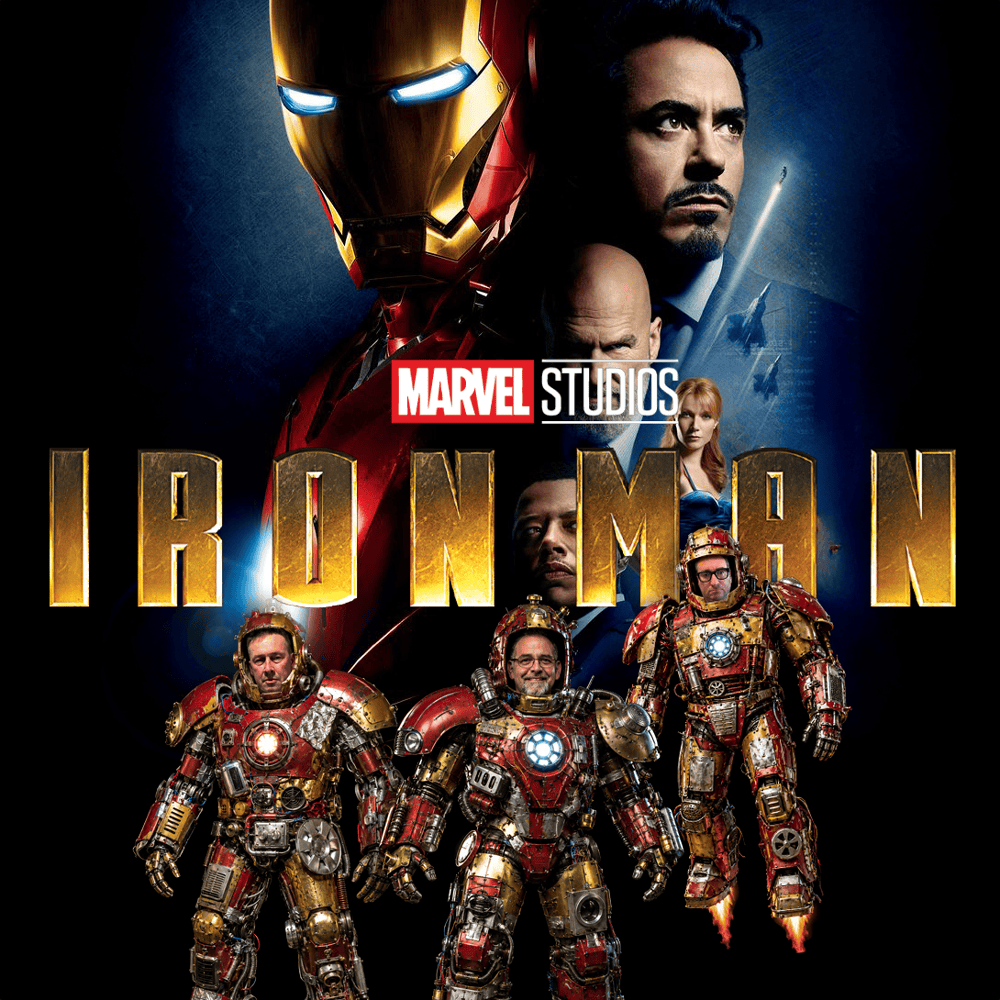
Movie TitleIron Man
Release DateApril 28, 2008 (Australian premiere) · May 2, 2008 (USA wide release)
Tagline"Heroes aren't born. They're built."
Runtime126 min / 2h 6m
DirectorJon Favreau
ScreenplayMark Fergus, Hawk Ostby, Art Marcum, Matt Holloway
Based OnIron Man by Stan Lee, Larry Lieber, Don Heck & Jack Kirby (Marvel Comics, first appearance Tales of Suspense #39, 1963)
CinematographerMatthew Libatique
Country of OriginUnited States
Sequel / FranchiseFilm #1 of the Marvel Cinematic Universe (MCU); followed by Iron Man 2 (2010) and Iron Man 3 (2013)
Budget~$140 million
Box Office$318.6 million domestic / $585.2 million worldwide — a massive hit that earned back more than four times its production budget and launched the most lucrative franchise in cinema history
Rotten Tomatoes94% Critics / 91% Audience
Metacritic79 / 100 · 8.1 User
IMDb Rating7.9/10
MPAA RatingPG-13 — Sequences of sci-fi action and violence, and brief suggestive content
Content WarningsIntense action violence and combat, weapons/missile imagery, moderate language, brief sexual innuendo, alcohol consumption, depictions of captivity and torture-adjacent peril, on-screen character deaths
Where to WatchDisney+ (primary streaming home); available for rent/purchase on Prime Video, Apple TV+, Vudu, and Google Play
Main Cast
Robert Downey Jr.Tony Stark / Iron Man
Gwyneth PaltrowPepper Potts
Jeff BridgesObadiah Stane / Iron Monger
Terrence HowardLt. Col. James "Rhodey" Rhodes
Leslie BibbChristine Everhart
Shaun ToubYinsen
Faran TahirRaza
Clark GreggAgent Phil Coulson
Jon FavreauHappy Hogan
Paul BettanyJARVIS (voice)
Samuel L. JacksonNick Fury (post-credits)
Tim GuineeAir Force Pilot / Colonel Rhodes's Subordinate
Awards
⭐ Academy Awards (Oscars) — Best Visual Effects — Nominated — 2009
⭐ Academy Awards (Oscars) — Best Sound Editing — Nominated — 2009
⭐ Saturn Awards — Best Science Fiction Film — Won — 2009
⭐ Saturn Awards — Best Actor (Robert Downey Jr.) — Won — 2009
⭐ MTV Movie Awards — Best Summer Movie So Far — Won — 2008
⭐ Teen Choice Awards — Choice Movie: Action Adventure — Won — 2008
⭐ Visual Effects Society — Outstanding Visual Effects in a Visual Effects-Driven Feature Motion Picture — Nominated — 2009
⭐ BAFTA Awards — Best Special Visual Effects — Nominated — 2009
Plot Summary
Tony Stark (Robert Downey Jr.) is a brilliant, arrogant billionaire weapons manufacturer and CEO of Stark Industries who is captured by a terrorist group called the Ten Rings in Afghanistan while demonstrating a new missile system. With the help of fellow captive and physicist Ho Yinsen (Shaun Toub), Tony secretly constructs a crude but powerful suit of powered armor — and the first miniaturized arc reactor chest piece — to escape captivity, though Yinsen sacrifices himself in the process. Back in the United States, Tony is deeply changed by the experience; he announces that Stark Industries will cease weapons manufacturing, building an increasingly sophisticated Iron Man suit in secret. He eventually discovers that his trusted mentor and business partner Obadiah Stane (Jeff Bridges) has been illicitly selling Stark weapons to terrorist groups and arranged for Tony's kidnapping, and is now constructing his own enormous Iron Monger armor using Tony's stolen technology. In a climactic rooftop battle, Tony defeats Stane and, in a move that defies conventional superhero secrecy, stands before a press conference and announces to the world: "I am Iron Man."
↑ Return to Top
Key Quotes
"I am Iron Man." — Tony Stark
"I shouldn't be alive... unless it was for a reason. I'm not crazy, Pepper. I just finally know what I have to do. And I know in my heart that it's right." — Tony Stark
"Don't waste it. Don't waste your life, Stark." — Yinsen
"I've successfully privatized world peace." — Tony Stark
"Obadiah Stane: It's a shame the director has to miss the moment his life's work has finally been realized. Tony Stark: Next time, baby." — Obadiah Stane & Tony Stark
"Mr. Stark, I'm Agent Phil Coulson with the Strategic Homeland Intervention, Enforcement and Logistics Division. Tony Stark: That's quite a mouthful." — Phil Coulson & Tony Stark
Trivia
Director
- Jon Favreau had previously directed Elf (2003) and Zathura (2005) before Marvel tapped him for Iron Man, a risky choice that proved transformative for the studio.
- Favreau was a vocal advocate for casting Robert Downey Jr. at a time when the actor's troubled personal history made studios nervous; Favreau had to personally lobby Marvel executives to approve the casting.
- Favreau deliberately avoided over-reliance on a rigid script, encouraging extensive improvisation on set — a strategy that shaped the film's uniquely loose, conversational tone.
- Favreau also plays Happy Hogan, Tony Stark's chauffeur and bodyguard, reprising the role across multiple MCU films.
- The director has cited Howard Hawks's adventure films and the James Bond franchise as key tonal references while developing the project.
Cast / Casting
- Robert Downey Jr. was initially considered too risky a choice by Marvel executives due to his well-publicized personal struggles; producer Kevin Feige and Jon Favreau championed him relentlessly.
- Tom Cruise was at one point in talks to play Tony Stark, and Nicolas Cage was also reported to have been considered.
- Terrence Howard was the highest-paid actor on the film, earning more than Downey; he was replaced by Don Cheadle in Iron Man 2 (2010) following a salary dispute.
- Gwyneth Paltrow said she improvised many of her scenes with Downey Jr., and the two developed their chemistry through natural conversation rather than scripted exchanges.
- Samuel L. Jackson's post-credits appearance as Nick Fury was a Marvel Comics in-joke — the "Ultimates" comic version of Fury was visually modeled on Jackson years before the casting.
Soundtrack / Score
- The score was composed by Ramin Djawadi, who would later go on to compose the iconic Game of Thrones theme.
- AC/DC's "Back in Black" opens the film and became closely associated with Tony Stark's character; the band's music features prominently throughout.
- Black Sabbath's "Iron Man" was notably not included in the film despite the obvious connection — Favreau felt it would be too on-the-nose.
- The use of classic hard rock tracks was intentional to establish Tony Stark's larger-than-life, rock-star personality from the very first scene.
- Djawadi was brought in relatively late in post-production, replacing initial composer Gabriel Yared, which limited the time available for the score.
Location
- The Afghanistan cave sequences were filmed entirely on a soundstage in Los Angeles, with a small amount of desert exterior work shot in Lone Pine, California.
- Stark's Malibu mansion was represented by an exterior shot of a real cliffside house in Malibu, though interior scenes were built on sets in Los Angeles.
- Stark Expo / Stark Industries exterior scenes used real industrial locations in the greater Los Angeles area, including Edwards Air Force Base for some aerial sequences.
- The freeway action sequence was filmed on a specially constructed set, not on an active California highway.
- The film was one of the first major productions to use Downey Industrial Complex in Downey, California as a primary production hub.
Behind-The-Scenes
- Much of the dialogue was improvised because the script was still being written during production — the cast would sometimes receive new pages on the day of shooting.
- The original Iron Man armor (Mark I) built in the cave was a practical suit weighing approximately 90 pounds, making movement extremely difficult for Downey.
- The later suits were partially practical and partially CGI; Industrial Light & Magic (ILM) handled the visual effects, requiring more than 500 effects shots.
- The post-credits scene featuring Nick Fury was shot in one day and was not part of the original plan — it was added to tease the concept of a shared cinematic universe.
- Iron Man was Marvel Studios' first self-financed production after the studio secured a $525 million revolving credit facility — the film's success essentially validated the entire MCU model.
Nostalgia
- Iron Man is widely regarded as the film that launched the modern superhero cinematic universe era, directly inspiring rival studios to pursue their own shared-universe strategies.
- The film's 2008 release came just weeks after The Dark Knight (also 2008), making that summer one of the most celebrated in superhero movie history.
- Robert Downey Jr.'s casting is often cited as one of Hollywood's greatest career rehabilitation stories — Iron Man re-established him as a bankable A-list star after years of personal difficulties.
- The "I am Iron Man" press conference ending, breaking the traditional superhero secret-identity trope, was considered revolutionary at the time and is still referenced as a defining pop-culture moment.
- AC/DC's "Back in Black" experienced a significant sales revival following the film's release, introducing the band to a new generation of fans.
Easter Eggs
- Captain America's shield can be spotted in Tony Stark's workshop, visible on a workbench in the background — an early tease for the broader MCU.
- The S.H.I.E.L.D. logo appears subtly in several scenes before the organization is fully named, rewarding eagle-eyed Marvel Comics fans.
- Tony's AI assistant J.A.R.V.I.S. is a nod to Edwin Jarvis, the Stark family butler from the comics.
- The Ten Rings terrorist organization is a direct reference to the Mandarin, Iron Man's classic comic-book nemesis, who would later appear in Iron Man 3 (2013).
- Nick Fury's post-credits line about "the Avenger Initiative" was the very first tease of what would eventually become Avengers (2012), planting a seed that audiences did not fully understand until later.
Misc.
- Iron Man was the first film released under the Marvel Studios banner as an independent producer — all previous Marvel-character films (Spider-Man, X-Men, Blade) had been made by other studios licensing the characters.
- The film holds a CinemaScore of "A," indicating exceptional audience response on opening weekend.
- Robert Downey Jr. would go on to appear as Tony Stark / Iron Man in a total of ten MCU films before the character's death in Avengers: Endgame (2019).
- The film's domestic opening weekend gross of $98.6 million set a record at the time for a non-sequel superhero film.
- Iron Man was ranked #26 on Empire magazine's 2008 list of the 500 Greatest Movies of All Time shortly after its release.
Soundtrack
Iron Man (Original Motion Picture Soundtrack) Ramin Djawadi · 21 tracks · 1:08:47
1
Iron Man
Ramin Djawadi
2:06
2
Merchant of Death
Ramin Djawadi
2:43
3
Capture
Ramin Djawadi
3:46
4
Imprisoned
Ramin Djawadi
3:25
5
Mark I
Ramin Djawadi
4:51
6
Escape
Ramin Djawadi
3:27
7
Driving with the Top Down
Ramin Djawadi
3:08
8
Miniaturization
Ramin Djawadi
2:53
9
First Flight
Ramin Djawadi
5:10
10
training flight / Airforce Rescue
Ramin Djawadi
4:07
11
Sword in the Stone
Ramin Djawadi
2:22
12
Obadiah
Ramin Djawadi
2:57
13
Iron Man vs. Iron Monger
Ramin Djawadi
7:13
14
From the Ashes
Ramin Djawadi
3:03
15
I Am Iron Man
Ramin Djawadi
2:36
Licensed Songs
16
Iron Man
Black Sabbath
5:55
17
Back in Black
AC/DC
4:15
18
Institutionalized
Suicidal Tendencies
4:04
19
Shoot to Thrill
AC/DC
5:17
20
Make It Up as I Go
Jon Favreau ft. Ghostface Killah & Raekwon
3:29
21
Pepper
Butthole Surfers
3:43
If You Liked This, Watch Next
Other movies reviewed by 3 Guys and a Flick that fans of Iron Man tend to love — all rated above 3.5.
↑ Return to Top
Sources Cited
3 Guys and a Flick - Latest Episode
3 Guys and a Flick - Ratings
IMDb - Iron Man
IMDb - Full Cast & Crew
IMDb - Awards
IMDb - Quotes
IMDb - Taglines
IMDb - Soundtrack
IMDb - Filming Locations
IMDb - Trivia
Box Office Mojo - Iron Man
The Numbers - Iron Man
Rotten Tomatoes - Iron Man
Metacritic - Iron Man
Wikipedia - Iron Man
Show notes generated August 5, 2026. Content reflects information available at time of generation.
↑ Return to Top