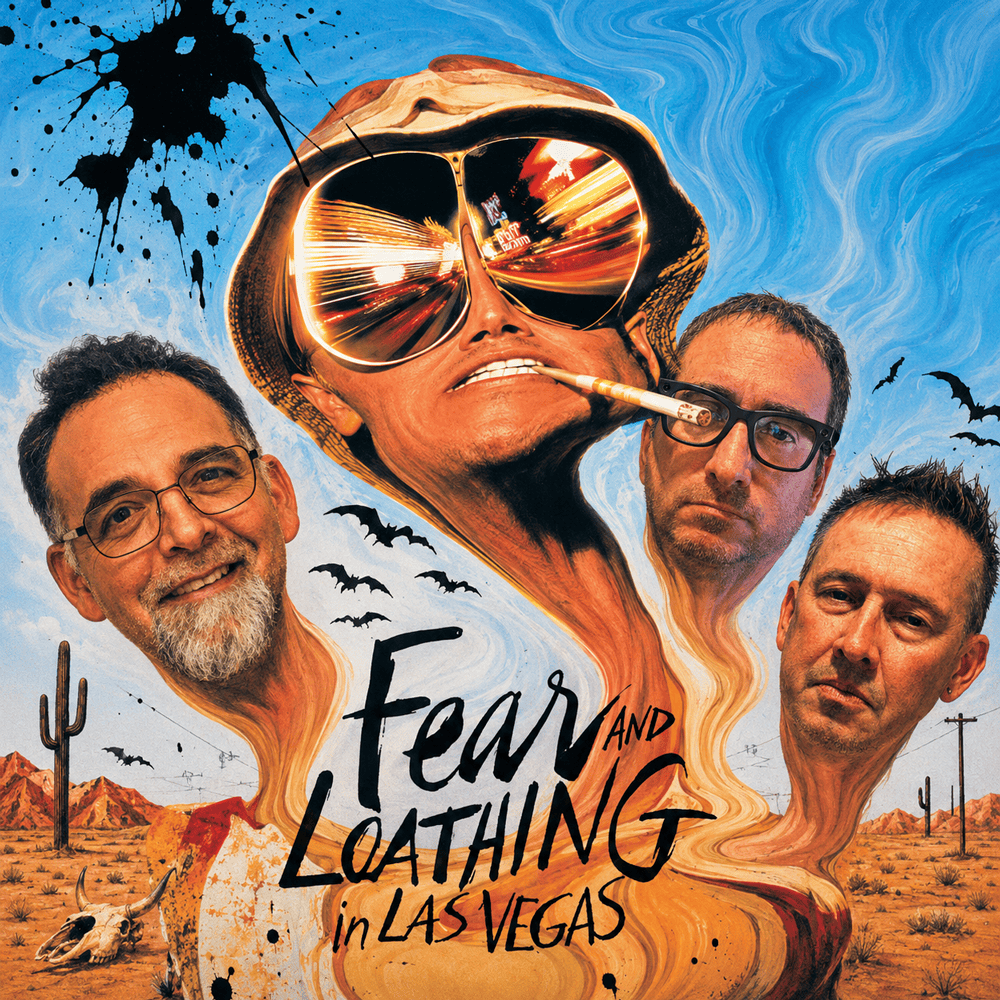
Details
Movie TitleFear and Loathing in Las Vegas
Release DateMay 22, 1998 (Cannes premiere May 15, 1998)
Tagline"Buy the ticket, take the ride."
Runtime118 min / 1 hr 58 min
DirectorTerry Gilliam
ScreenplayTerry Gilliam, Tony Grisoni, Tod Davies, Alex Cox
Based OnFear and Loathing in Las Vegas (1971 novel) by Hunter S. Thompson
CinematographerNicola Pecorini
Country of OriginUnited States
Sequel / FranchiseStandalone film; no sequels
Budget~$18.5 million
Box Office~$13.7 million worldwide — a box office disappointment against its budget, though it has since earned cult classic status
Rotten Tomatoes50% Critics / 89% Audience
Metacritic41 / 100 · 8.5 User
IMDb Rating7.6/10
MPAA RatingR — for pervasive extreme drug and alcohol use, and language
Content WarningsConstant depictions of illegal drug and alcohol use, strong language, disturbing hallucination sequences, brief nudity, erratic and dangerous behavior
Where to WatchAvailable for rent/purchase on Amazon Prime Video, Apple TV+, Vudu, and other major platforms
Main Cast
Johnny DeppRaoul Duke (Hunter S. Thompson)
Benicio del ToroDr. Gonzo
Tobey MaguireHitchhiker
Ellen BarkinNorth Star Waitress
Gary BuseyHighway Patrolman
Cameron DiazBlonde TV Reporter
Christina RicciLucy
Katherine HelmondDesk Clerk
Harry Dean StantonJudge
Craig BierkoLacerda
Mark HarmonMagazine Reporter
FleaMusician
Awards
⭐ Cannes Film Festival — Palme d'Or — Nominated — Terry Gilliam — 1998
⭐ Russian Guild of Film Critics — Golden Aries, Best Foreign Actor — Won — Johnny Depp — 1998
⭐ Stinkers Bad Movie Awards — Worst On-Screen Couple — Nominated — Johnny Depp & Benicio del Toro — 1998
⭐ Stinkers Bad Movie Awards — Worst Supporting Actor — Nominated — Benicio del Toro — 1998
⭐ Saturn Awards — Best Fantasy Film — Nominated — 1999
⭐ MTV Movie Awards — Best Male Performance — Nominated — Johnny Depp — 1999
⭐ Empire Awards — Best Actor — Nominated — Johnny Depp — 1999
⭐ Online Film Critics Society — Best Picture — Nominated — 1999
Plot Summary
It is 1971. Gonzo journalist Raoul Duke (Johnny Depp) and his attorney Dr. Gonzo (Benicio del Toro) set out from Los Angeles for Las Vegas in a red Chevy Impala convertible, ostensibly to cover the Mint 400 motorcycle race for a sports magazine. Their luggage consists of a staggering arsenal of recreational substances. What follows is less a coherent narrative than a delirious series of episodic encounters — hotel rooms destroyed, waitresses terrorized, a police officers' drug conference attended, and a second Las Vegas trip undertaken — as Duke desperately attempts to pursue the fading ghost of the American Dream across the neon wasteland of early-70s Vegas. The film is framed by Duke's sardonic voiceover narration, drawn almost verbatim from Thompson's novel, which gives the hallucinatory chaos a melancholic subtext: the hippie generation's idealism has curdled, the counterculture wave has broken, and all that remains is excess, paranoia, and the wreckage of a beautiful idea.
↑ Return to Top
Key Quotes
"We were somewhere around Barstow, on the edge of the desert, when the drugs began to take hold." — Raoul Duke
"Buy the ticket, take the ride." — Raoul Duke
"There he goes. One of God's own prototypes. A high-powered mutant of some kind never even considered for mass production." — Raoul Duke
"As your attorney, I advise you to take a hit out of the little brown bottle in my shaving kit." — Dr. Gonzo
"No sympathy for the devil; keep that in mind. Buy the ticket, take the ride... and if it occasionally gets a little heavier than what you had in mind, well... maybe chalk it up to forced exposure." — Raoul Duke
"This is bat country!" — Raoul Duke
Trivia
Director
- Terry Gilliam had wanted to adapt Thompson's novel for years, but feared it was unfilmable. He finally committed after a 13-week development sprint with co-writer Tony Grisoni.
- Gilliam shot much of the film in sequence to help Depp and del Toro sustain their chemically-altered performances across the shoot.
- The film was an official selection at the 1998 Cannes Film Festival, where it was nominated for the Palme d'Or — an unusual honor for such a deliberately anarchic studio release.
- Gilliam used a wide-angle lens almost exclusively throughout the film to distort reality and simulate the perceptual warping of substance intoxication.
- The director has said the film is not about endorsing substance use but about capturing the moment America's idealistic counterculture imploded under its own excess.
Cast / Casting
- Johnny Depp spent months living with Hunter S. Thompson in Woody Creek, Colorado to prepare for the role, studying his mannerisms, speech patterns, and physical habits.
- Depp shaved his head to match Thompson's signature look, and Thompson himself reportedly described Depp's performance as watching himself from 30 years earlier.
- Benicio del Toro gained approximately 40 pounds for the role of Dr. Gonzo, a physical transformation that gave the character his looming, unpredictable physical presence.
- Tobey Maguire's role as the hitchhiker was filmed in a single night, with Maguire reportedly largely improvising his terrified reactions to Depp and del Toro's behavior.
- An extraordinary number of well-known actors took small cameo roles — Cameron Diaz, Christina Ricci, Gary Busey, Harry Dean Stanton, Lyle Lovett, Flea, and Mark Harmon all appear briefly.
Soundtrack / Score
- The soundtrack is a defining feature of the film — a curated blast of period-perfect late-60s and early-70s rock, including the Rolling Stones, Jefferson Airplane, Bob Dylan, and Credence Clearwater Revival.
- The opening scene uses "Jumpin' Jack Flash" by the Rolling Stones, immediately establishing the film's frenetic energy and period authenticity.
- Ray Cooper served as music supervisor, weaving licensed tracks into the film so seamlessly that the soundtrack itself functions as a character — the sound of a generation in free fall.
- The song "White Rabbit" by Jefferson Airplane is used with devastating irony, its Alice in Wonderland psychedelia recontextualised as both celebration and eulogy.
- The soundtrack album was praised separately from the film and became a popular standalone release, introducing many younger listeners to the era's rock music.
Location
- Despite being set in Las Vegas, much of the filming was done in Los Angeles, with location photography in Las Vegas confined to specific exteriors the production could control.
- The film recreates the Circus Circus casino environment extensively, with production designer Alex McDowell building elaborate sets to capture its garish, carnivalesque atmosphere.
- The Barstow desert opening sequence was shot in the Mojave Desert near the actual stretch of highway described in Thompson's book.
- Many interior hotel room scenes were built on sound stages in Los Angeles to allow Gilliam full control over the increasingly surreal visual distortions.
- The real Mint Hotel, which hosted the actual Mint 400 race Thompson covered, had already been demolished by the time filming began, requiring careful period recreation.
Behind-The-Scenes
- Hunter S. Thompson made a brief cameo in the film — he appears in a flashback sequence as a young man sitting in a diner, watching Duke and Gonzo at the next table.
- The film's production was notoriously chaotic, mirroring the subject matter; Gilliam has described the shoot as both the most difficult and most satisfying of his career.
- The hallucinatory visual effects were achieved largely through practical lens work and in-camera techniques rather than CGI, giving the distortions an organic, queasy quality.
- Depp and del Toro reportedly stayed in character throughout large portions of the production, which led to genuinely unpredictable on-set behavior that Gilliam often incorporated into the film.
- The film was completed in approximately 16 weeks of principal photography on a relatively modest budget of $18.5 million.
Nostalgia
- The film is set in 1971 and captures the precise moment of cultural disillusionment that followed Woodstock, the Manson murders, and the collapse of the peace movement.
- Thompson's novel was itself a nostalgic document when published in 1972 — a eulogy for the 1960s ideal written in real time as it expired. Gilliam's film adds another layer of retrospective melancholy.
- For audiences who lived through the era, the film's soundtrack and visual period details function as a bittersweet time capsule of a specific American cultural moment.
- The film has grown significantly in cultural stature since its disappointing initial release, now ranked among the defining films of 1990s American cinema.
- Thompson himself called the film the most faithful adaptation of his work he had ever seen, high praise from a writer famous for despising Hollywood versions of his stories.
Easter Eggs
- Hunter S. Thompson's cameo is positioned so that the young Duke (Depp) glances back at him — the film's creator literally watching his own creation, a meta-textual wink to fans of the novel.
- Several lines of Duke's voiceover are lifted verbatim from Thompson's novel with only minimal alteration, rewarding readers who know the source text.
- The number on Duke's hotel room changes between scenes, a deliberate continuity error Gilliam included to suggest the unreliability of Duke's drug-altered perception.
- The bat hallucination in the opening sequence uses practical puppetry and forced perspective rather than CGI — on close viewing, the bats are visibly physical objects, adding to the surreal texture.
- The carpet patterns in the hotel scenes are period-accurate reproductions of actual Las Vegas hotel carpeting from the early 1970s, an obsessive production design detail most viewers never notice.
Misc.
- The film earned only $13.7 million against its $18.5 million budget on original release, making it a commercial failure — yet it has since sold millions of home video copies and is considered a cult classic.
- Roger Ebert famously gave the film one star on original release, calling it "a horrible experience." He later revisited and softened his view somewhat, acknowledging its technical achievements.
- The film holds a 50% Tomatometer from critics but an 89% Audience Score — one of the larger critic/audience divides in modern cinema history, reflecting its polarizing nature.
- Johnny Depp and Hunter Thompson remained close friends after filming; Depp later financed and arranged Thompson's funeral, including the famous cannon firing of Thompson's ashes.
- The film has been credited with introducing an entire generation to Thompson's writing and the broader Gonzo journalism tradition, functioning as a gateway to his literary legacy.
Soundtrack
Fear and Loathing in Las Vegas: Music from the Motion Picture Various Artists / Music Supervisor: Ray Cooper · 19 tracks
1
Jumpin' Jack Flash
The Rolling Stones
3:42
2
Expecting to Fly
Buffalo Springfield
3:41
3
White Rabbit
Jefferson Airplane
2:32
4
Sympathy for the Devil
The Rolling Stones
6:18
5
Tiny Bubbles
Don Ho
2:26
6
My Favorite Things
Eric Clapton
4:44
7
One Toke Over the Line
Brewer & Shipley
3:12
8
Burning of the Midnight Lamp
Jimi Hendrix
3:34
9
Combination of the Two
Big Brother & The Holding Company
4:53
10
Magic Carpet Ride
Steppenwolf
4:26
11
Love Hurts
The Everly Brothers
2:16
12
Tammy
Debbie Reynolds
2:47
13
Ride the Wild Surf
Jan & Dean
2:18
14
Viva Las Vegas
Dead Kennedys
1:56
15
Midnight Rambler
The Rolling Stones
6:52
16
She Smiled Sweetly
The Rolling Stones
2:43
17
Tommy the Cat
Primus
5:03
18
L.A. Woman
The Doors
7:50
19
Stuck in the Middle with You
Stealers Wheel
3:28
If You Liked This, Watch Next
Other movies reviewed by 3 Guys and a Flick that fans of Fear and Loathing in Las Vegas tend to love — all rated above 3.5.
↑ Return to TopSources Cited
3 Guys and a Flick - Latest Episode
3 Guys and a Flick - Ratings
IMDb - Fear and Loathing in Las Vegas
IMDb - Full Cast & Crew
IMDb - Awards
IMDb - Quotes
IMDb - Taglines
IMDb - Soundtrack
IMDb - Filming Locations
IMDb - Trivia
Box Office Mojo - Fear and Loathing
The Numbers - Fear and Loathing
Rotten Tomatoes - Fear and Loathing
Metacritic - Fear and Loathing
Wikipedia - Fear and Loathing
Show notes generated August 26, 2026. Content reflects information available at time of generation.
↑ Return to Top