Details
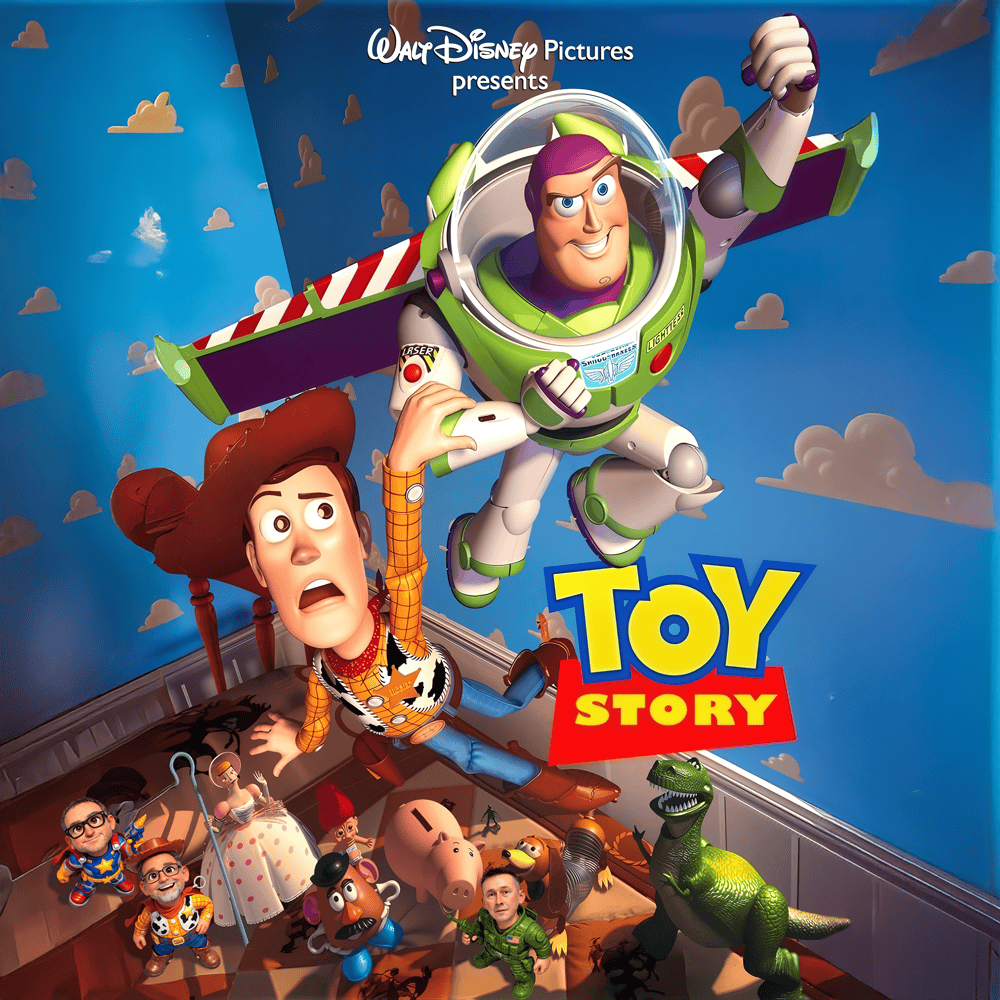
Movie TitleToy Story
Release DateNovember 22, 1995
TaglineThe adventure takes off!
Runtime81 minutes
DirectorJohn Lasseter
Screenplay Written ByJoss Whedon, Andrew Stanton, Joel Cohen & Alec Sokolow
Based OnOriginal story by John Lasseter, Pete Docter, Andrew Stanton & Joe Ranft
Is It a Remake?No. Toy Story is an original Pixar animated feature and the first feature-length computer-animated film.
BudgetApproximately $30 million
Box OfficeApprox. $229.9 million domestic / Approx. $401.2 million worldwide
Main Cast
Tom HanksWoody
Tim AllenBuzz Lightyear
Don RicklesMr. Potato Head
Jim VarneySlinky Dog
Wallace ShawnRex
John RatzenbergerHamm
Annie PottsBo Peep
John MorrisAndy
Erik von DettenSid
Laurie MetcalfMrs. Davis
R. Lee ErmeySarge
Sarah FreemanHannah
Awards
⭐ Academy Special Achievement Award — John Lasseter, for the development and inspired application of techniques that made the first feature-length computer-animated film possible
⭐ Academy Award Nominee — Best Original Screenplay
⭐ Academy Award Nominee — Best Original Song, “You’ve Got a Friend in Me”
⭐ Academy Award Nominee — Best Original Musical or Comedy Score
⭐ Golden Globe Nominee — Best Motion Picture, Comedy or Musical
⭐ Golden Globe Nominee — Best Original Song, “You’ve Got a Friend in Me”
⭐ Saturn Award Winner — Best Fantasy Film
⭐ National Film Registry — Selected for preservation by the Library of Congress in 2005
⭐ AFI Recognition — Ranked #99 on AFI’s 100 Years…100 Movies 10th Anniversary list and #6 on AFI’s Top 10 Animated Films list
Short Plot Summary
Woody, Andy’s favorite cowboy doll, has his comfortable place at the top of the toy box threatened when shiny new space ranger Buzz Lightyear arrives. Buzz believes he is a real galactic hero, while Woody sees him as a plastic rival. When jealousy gets both toys stranded outside the safety of Andy’s room, Woody and Buzz must survive Sid, moving day, and their own egos before learning what it really means to be there for a friend.
↑ Return to Top
Key Quotes
“To infinity and beyond!” — Buzz Lightyear
“There’s a snake in my boot!” — Woody
“You are a toy!” — Woody
“The claw!” — Little Green Men
“You’ve got a friend in me.” — Randy Newman
Trivia
Director
- Toy Story was directed by John Lasseter, making his feature-film directing debut.
- The screenplay was written by Joss Whedon, Andrew Stanton, Joel Cohen, and Alec Sokolow.
- The story is credited to John Lasseter, Pete Docter, Andrew Stanton, and Joe Ranft.
- The film began as an evolution of Pixar’s earlier computer-animated short work and became the first fully computer-animated feature film.
Cast / Casting
- Tom Hanks voices Woody, Andy’s favorite cowboy doll and the unofficial leader of the toys.
- Tim Allen voices Buzz Lightyear, the new space ranger toy who initially believes he is an actual intergalactic hero.
- Don Rickles, Jim Varney, Wallace Shawn, John Ratzenberger, and Annie Potts help fill out Andy’s toy box.
- John Ratzenberger’s role as Hamm began his long-running association with Pixar voice cameos.
Soundtrack / Score
- The songs and score were written by Randy Newman.
- “You’ve Got a Friend in Me” became the signature song of the film and the broader franchise.
- The song earned an Academy Award nomination for Best Original Song.
- The score also earned an Academy Award nomination for Best Original Musical or Comedy Score.
Location
- The story is set largely in Andy’s bedroom, Sid’s house, Pizza Planet, and the neighborhood around Andy’s home.
- Unlike live-action films, Toy Story was created digitally through Pixar’s computer-animation pipeline rather than filmed on physical locations.
- The domestic spaces are designed from a toy’s-eye perspective, making beds, stairs, cars, and moving boxes feel huge and dangerous.
- Pizza Planet became one of Pixar’s most memorable fictional locations and inspired later Pixar Easter eggs.
Behind-The-Scenes
- Toy Story was produced by Pixar Animation Studios and Walt Disney Pictures.
- The movie was the first feature-length film made entirely with computer animation.
- The film’s success helped transform Pixar from a technology company and short-film studio into a major feature-animation studio.
- John Lasseter received a Special Achievement Academy Award for the film’s groundbreaking computer-animation work.
- The film grossed approximately $401.2 million worldwide across all releases.
Nostalgia
- Toy Story launched one of the most beloved animated franchises in movie history.
- For many viewers, Woody and Buzz became the defining animated duo of the 1990s.
- The movie’s central idea — that toys come alive when humans leave the room — became instantly iconic.
- Its mix of kid-friendly adventure, adult-friendly jokes, and sincere friendship themes helped define the Pixar storytelling formula.
Easter Eggs
- Pizza Planet would go on to become one of Pixar’s most recurring Easter egg references.
- The Luxo ball, tied to Pixar’s classic short Luxo Jr., appears in the film.
- Buzz’s belief that he is not a toy gives the movie one of its funniest running jokes and its emotional identity crisis.
- The claw-machine aliens became fan-favorite side characters and returned in later Toy Story films.
Misc.
- Toy Story is rated G and runs 81 minutes.
- The film opened in North America on November 22, 1995.
- AFI ranks Toy Story among the greatest American films and among the top animated American films.
- Your 3 Guys and a Flick ratings page lists the episode as Episode 252, with Don rating it 4.25, Ken rating it 4.25, Jon rating it 4.75, and an overall rating of 4.42.
Sources Cited
3 Guys and a Flick — Podcast 252: Toy Story
3 Guys and a Flick — Ratings
IMDb — Toy Story
IMDb — Toy Story Full Cast & Crew
IMDb — Toy Story Awards
IMDb — Toy Story Quotes
IMDb — Toy Story Taglines
AFI Catalog — Toy Story
AFI Movie Club — Toy Story
Box Office Mojo — Toy Story
The Numbers — Toy Story
Rotten Tomatoes — Toy Story
Oscars — 1996 Ceremony
Apple Music — Toy Story Soundtrack
Wikipedia — Toy Story
↑ Return to Top