Details
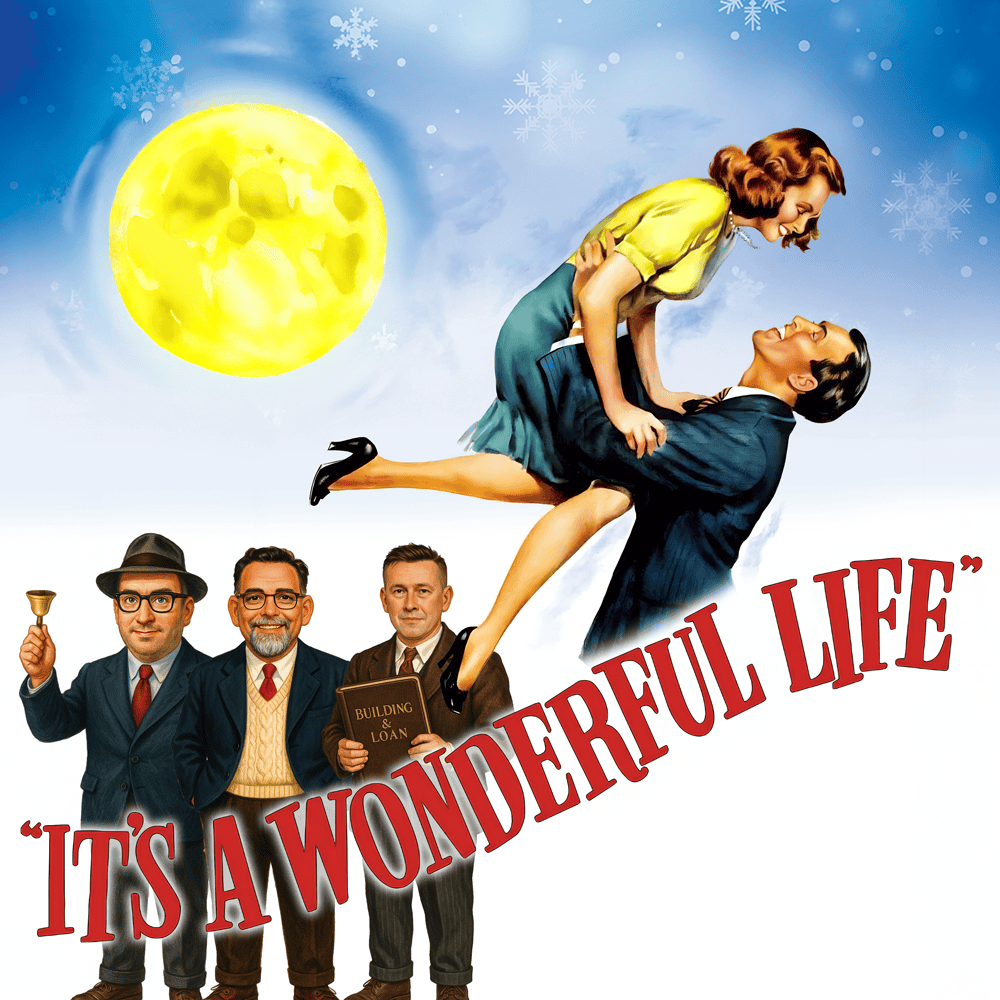
Movie TitleIt’s a Wonderful Life
Release DateDecember 20, 1946
TaglineThey’re making memories tonight!
Runtime129 minutes
DirectorFrank Capra
Screenplay Written ByFrances Goodrich, Albert Hackett & Frank Capra; additional scenes by Jo Swerling
Based OnPhilip Van Doren Stern’s short story The Greatest Gift
Is It a Remake?No. It is an original film adaptation of Stern’s story. It was later remade for television as It Happened One Christmas in 1977.
BudgetApproximately $3.18 million
Box OfficeApprox. $3.3 million original theatrical gross; later re-release grosses vary by source
Main Cast
James StewartGeorge Bailey
Donna ReedMary Hatch Bailey
Lionel BarrymoreMr. Henry F. Potter
Thomas MitchellUncle Billy
Henry TraversClarence Oddbody
Beulah BondiMrs. Bailey
Frank FaylenErnie Bishop
Ward BondBert
Gloria GrahameViolet Bick
H.B. WarnerMr. Gower
Todd KarnsHarry Bailey
Samuel S. HindsPa Bailey
Awards
⭐ Academy Award Nominee — Best Picture
⭐ Academy Award Nominee — Best Director: Frank Capra
⭐ Academy Award Nominee — Best Actor: James Stewart
⭐ Academy Award Nominee — Best Film Editing: William Hornbeck
⭐ Academy Award Nominee — Best Sound Recording: John Aalberg and the RKO Radio Studio Sound Department
⭐ Golden Globe Winner — Best Director: Frank Capra
⭐ National Film Registry — Selected for preservation in 1990 by the Library of Congress
⭐ American Film Institute — Ranked #1 on AFI’s 100 Years…100 Cheers list of the most inspiring American films
Short Plot Summary
George Bailey spends his life giving up his own dreams to help the people of Bedford Falls through his family’s Building and Loan. On Christmas Eve, after a misplaced deposit gives the vicious Mr. Potter a chance to ruin him, George reaches a breaking point and wishes he had never been born. Clarence, an angel trying to earn his wings, shows George what the world would look like without him — revealing how many lives George has changed simply by being there.
↑ Return to Top
Key Quotes
“Every time a bell rings, an angel gets his wings.” — Zuzu Bailey
“No man is a failure who has friends.” — Clarence Oddbody
“I want to live again!” — George Bailey
“To my big brother George, the richest man in town.” — Harry Bailey
“Merry Christmas, you wonderful old Building and Loan!” — George Bailey
“Remember, George: no man is a failure who has friends.” — Clarence Oddbody
Trivia
Director
- It’s a Wonderful Life was directed and produced by Frank Capra.
- The film was the first production from Liberty Films, the company Capra formed with William Wyler, George Stevens, and Samuel J. Briskin after World War II.
- Capra co-wrote the screenplay with Frances Goodrich and Albert Hackett, with additional scenes credited to Jo Swerling.
- The film marked Capra’s return to commercial filmmaking after his wartime service and documentary work.
Cast / Casting
- James Stewart plays George Bailey in his first film role after serving in World War II.
- Donna Reed plays Mary Hatch Bailey, George’s wife and one of the emotional anchors of the story.
- Lionel Barrymore plays the villainous Mr. Potter, Bedford Falls’ richest and most ruthless man.
- Henry Travers plays Clarence Oddbody, the second-class angel assigned to help George.
- AFI notes that Todd Karns replaced David McKay as Harry Bailey due to a change in McKay’s draft status.
Soundtrack / Score
- The music score was written and directed by Dimitri Tiomkin.
- AFI lists “Buffalo Gal (Won’t You Come Out Tonight?)” as a key song in the film.
- The film also uses “Auld Lang Syne” in its famous closing sequence.
- The music supports the film’s tonal mix of small-town comedy, romance, fantasy, despair, and emotional Christmas uplift.
Location
- The story is set in the fictional town of Bedford Falls, New York.
- AFI lists production at RKO-Pathé Studios, with filming running from April 15 through July 27, 1946.
- AFI notes that some scenes were filmed at the RKO Ranch in Encino, California.
- The Bedford Falls set was built on a massive backlot and became one of the most memorable fictional small towns in American film.
Behind-The-Scenes
- Philip Van Doren Stern’s story began as a Christmas-card booklet called The Greatest Gift.
- RKO originally bought the screen rights as a possible Cary Grant vehicle before the property was sold to Liberty Films.
- AFI notes that the film required a major artificial snowstorm effect during production.
- Russell Shearman and the effects team helped develop more realistic-looking movie snow for the production.
- The film underperformed during its original release but later became a holiday classic through television broadcasts and annual rewatching.
Nostalgia
- It’s a Wonderful Life has become one of the defining American Christmas movies, despite not being an immediate box-office hit.
- The film’s annual television presence helped turn it from a modest 1946 performer into a beloved holiday tradition.
- George Bailey’s panic, frustration, sacrifice, and final gratitude are a big reason the movie remains emotionally powerful decades later.
- Bedford Falls, the Building and Loan, Martini’s, the gym-floor dance, and the Christmas Eve finale have become classic holiday-movie imagery.
Easter Eggs
- The film’s alternate-world Pottersville sequence shows how much George’s quiet, ordinary decency shaped Bedford Falls.
- The recurring bell motif pays off with the film’s famous final line about angels earning their wings.
- Clarence’s copy of The Adventures of Tom Sawyer connects back to George’s childhood longing for adventure.
- The broken staircase finial in the Bailey house becomes a running gag and a symbol of George’s domestic frustrations.
- The title itself is ironic for much of the film, only becoming fully meaningful after George sees the world without him.
Misc.
- It’s a Wonderful Life runs approximately 129 minutes in its most common version.
- Rotten Tomatoes’ critics consensus calls it the holiday classic that defines holiday classics.
- The film was nominated for five Academy Awards but did not win in those categories.
- It was selected for the National Film Registry in 1990.
- Your 3 Guys and a Flick ratings page lists the episode as Episode 239, with Don rating it 3.75, Ken rating it 4.75, Jon rating it 4.00, and an overall rating of 4.17.
Sources Cited
3 Guys and a Flick — Podcast 239: It’s a Wonderful Life
3 Guys and a Flick — Ratings
IMDb — It’s a Wonderful Life
IMDb — Full Cast & Crew
IMDb — Awards
IMDb — Quotes
IMDb — Taglines
IMDb — Soundtrack
IMDb — Filming Locations
AFI Catalog — It’s a Wonderful Life
AFI Catalog Spotlight — It’s a Wonderful Life
The Academy — 19th Academy Awards
The Academy — It’s a Wonderful Life Screening
Box Office Mojo — It’s a Wonderful Life
Rotten Tomatoes — It’s a Wonderful Life
Britannica — It’s a Wonderful Life
Wikipedia — It’s a Wonderful Life
↑ Return to Top